— Blog · 17 July 2026 · 4 min read
Birmingham: A Dynamic UK City for Ambitious Design and Building Projects
A practical guide to Birmingham’s architecture, construction costs and urban momentum, with insights for anyone planning a project in the UK’s second city.
Welcome to Birmingham
Birmingham is one of the UK’s most interesting cities for anyone considering a building, renovation or design project. The latest population estimate puts the city at roughly 1.16 million people, making it the largest city in the West Midlands and one of the most significant urban centres in England. It is a city shaped by industry, reinvention and a genuinely diverse architectural character, where historic civic buildings sit alongside bold contemporary schemes. For homeowners, developers and business owners alike, Birmingham offers scale, connectivity and a strong pool of local expertise, including experienced architects who understand the city’s mix of heritage, regeneration and modern growth.
What makes Birmingham especially notable is its ability to combine practicality with ambition. It has long been a place where commerce, transport and manufacturing drove urban expansion, and today that legacy continues in a more design-led form. The city’s centre has undergone major transformation over recent decades, while many neighbourhoods retain distinctive Victorian terraces, Georgian streets and post-war housing stock that offer opportunities for sensitive improvement and imaginative adaptation.
Architectural Highlights
Birmingham’s architecture tells the story of a city that has repeatedly reinvented itself. Historically, the city is known for its red-brick Victorian and Edwardian buildings, including the Council House and the Birmingham Museum and Art Gallery, which reflect the civic confidence of the industrial age. The Jewellery Quarter is another standout, with one of the largest concentrations of surviving Georgian and Victorian industrial buildings in Europe, giving the area a unique character that is ideal for conversion, restoration and detailed design work.
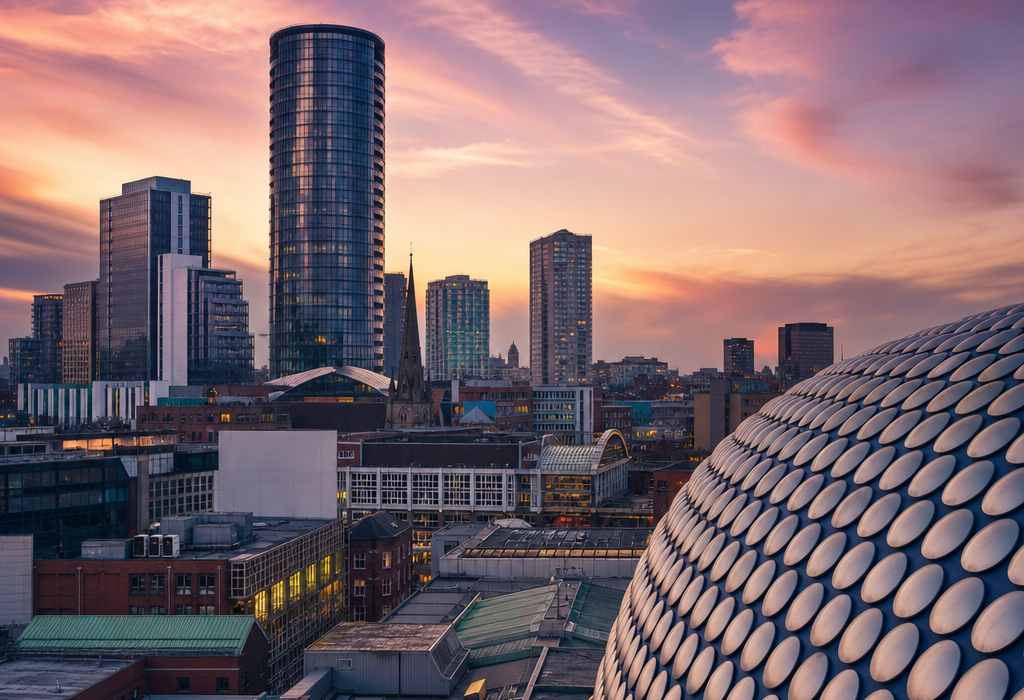
On the modern side, Birmingham is recognised for major examples of contemporary urban architecture such as the Library of Birmingham, whose bold stepped form has become a landmark on Centenary Square, and Grand Central above New Street station, which helped reshape the city’s transport and retail core. The Bullring area also illustrates the city’s appetite for striking modern design, with large-scale commercial architecture sitting beside older urban fabric. This combination of heritage and modernity gives Birmingham a rare depth: projects here can draw on both conservation-led craftsmanship and confident new-build thinking.
A key historical fact about Birmingham’s urban development is that the city expanded rapidly during the Industrial Revolution, with canals, workshops and factories driving dense growth and linking manufacturing districts to national trade routes. That canal network remains one of Birmingham’s defining urban features and is still visible in the city centre and surrounding neighbourhoods, adding character and development potential to waterside sites.
Construction Costs & Trends
For most projects in Birmingham, a sensible broad estimate for construction costs is around £1,700 to £2,500 per square metre for standard residential or mixed-use work, although higher-specification schemes, heritage properties and complex city-centre sites can cost more. Refurbishment and conversion work may fall outside that range depending on the condition of the building, access constraints and the level of structural or energy-efficiency upgrades required. As with anywhere in the UK, planning, design quality and build complexity can make a substantial difference to final costs.
In terms of current trends, Birmingham has been strongly shaped by city-centre regeneration, transport investment and a growing preference for higher-density urban living. Apartment-led development, brownfield redevelopment and the reuse of older commercial buildings have all become more prominent, especially around the centre, the Canal Quarter, Digbeth and areas linked to major rail and metro improvements. There is also a growing focus on sustainability, retrofit and better public realm design, reflecting both market demand and broader UK pressures to make existing urban land work harder.
Why Birmingham is Perfect for Your Project
Birmingham is an appealing city for building, renovating or designing because it offers the ingredients that make thoughtful architecture worthwhile: a large and diverse population, strong transport connections, varied building stock and an economy that continues to evolve. The city is home to multiple universities, established professional networks and a wide range of property types, from compact inner-city plots to period homes and large former industrial buildings. That variety creates opportunities for projects of almost every scale, whether you are updating a family house, reworking a commercial unit or developing a larger mixed-use scheme.
It is also a city where design can make a visible difference. In Birmingham, good architecture is not just about appearance; it is about unlocking difficult sites, improving energy performance, respecting heritage and creating spaces that feel useful and future-proof. The city’s ongoing regeneration means there is real momentum behind well-considered development, while its historic fabric rewards careful, informed decisions. For people planning a project, Birmingham offers both challenge and opportunity in equal measure: a place where practical building needs can meet genuine architectural ambition.
Find top professionals for your project in Birmingham
Free and with no obligation / Takes under 5 minutes
Are you an architect or designer? Register for free! »